
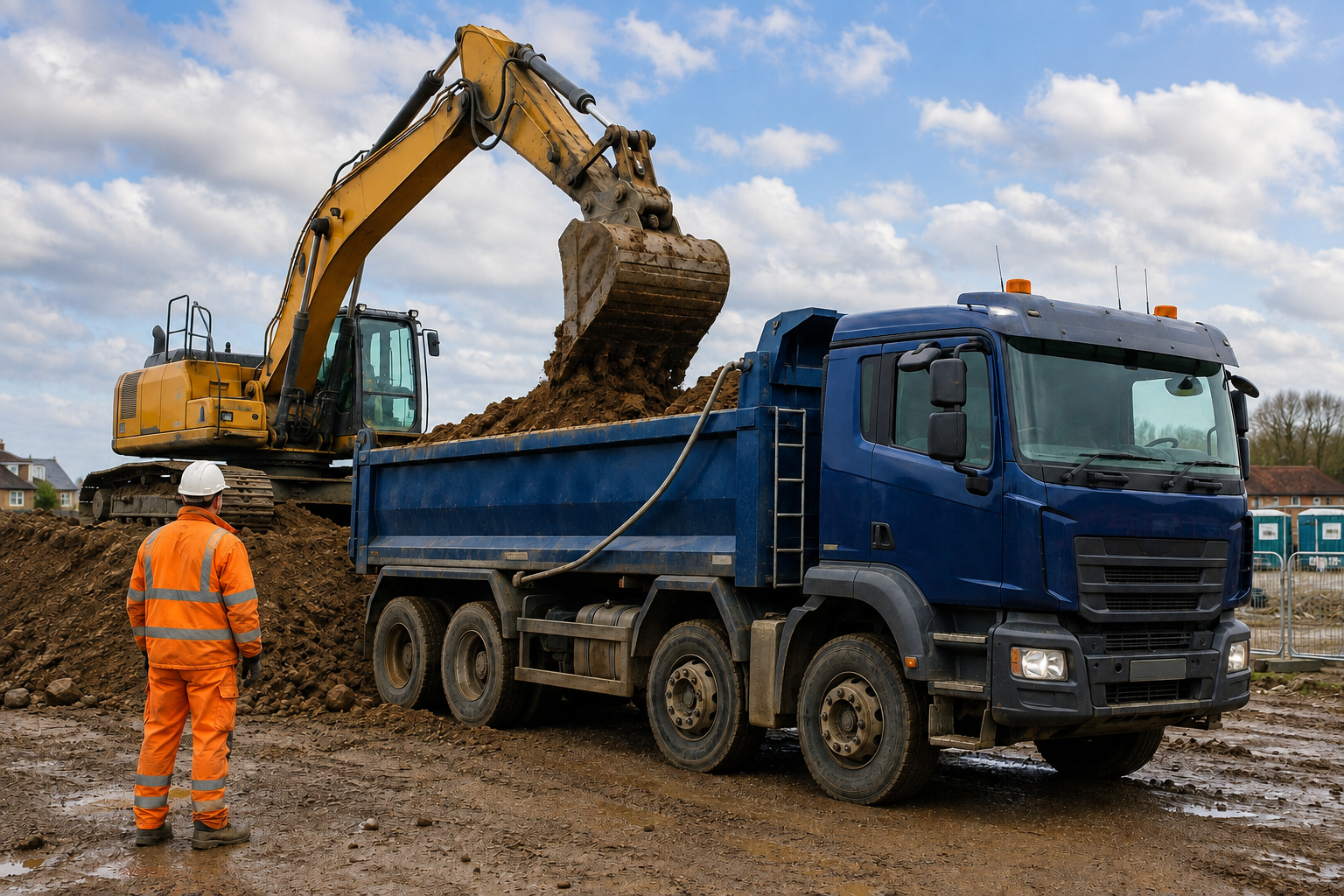
Construction Has Changed. Why Are So Many Tipper Companies Still Working Like It's 2005?
Walk onto almost any construction site in Ireland or the UK today and one thing becomes immediately obvious.
The industry has changed.
Project managers carry tablets instead of folders. Engineers review drawings on iPads. GPS-guided excavators work to millimetre accuracy. Drones survey sites in minutes. Artificial Intelligence is beginning to optimise planning, while Building Information Modelling (BIM) has become standard practice on many major projects.
This isn't just perception—it's measurable. Ireland's latest Build Digital Annual Survey found that digital transformation is now being driven by government requirements, client expectations and proven project benefits. Technologies such as digital documentation, model-based coordination and information management are becoming mainstream across the construction sector.
Construction isn't talking about digital transformation anymore.
It's already happening.
Yet one part of the supply chain often looks exactly as it did twenty years ago.
The tipper truck.
More specifically...
The paper delivery docket.
It's Not That Paper Doesn't Work
Let's be fair.
Paper delivery dockets have helped build motorways, housing estates, schools and hospitals for decades.
Nobody is suggesting they don't work.
The question is whether they're still the best way to run a modern haulage business.
If you were starting a new tipper company tomorrow, would you choose to buy thousands of printed dockets, filing cabinets, archive boxes, scanners and storage shelves?
Or would you build your business around instant access to every delivery from your phone or computer?
Most owners already know the answer.
Your Customers Have Changed
This is the biggest shift of all.
Your customers don't simply want loads delivered anymore.
They want information.
A site manager wants confirmation that today's aggregate arrived.
A quantity surveyor wants supporting documentation before approving an invoice.
A developer wants confidence that materials reached the correct destination.
An environmental manager wants traceability.
Nobody wants to wait until tomorrow because the paperwork is still sitting in the cab of a truck.
Construction has become an information-driven industry.
Hauliers are increasingly expected to deliver information just as efficiently as they deliver materials.
The Industry Is Becoming More Accountable
Across both Ireland and the UK, the focus on transparency and traceability is increasing.
In Ireland, government-backed initiatives such as Build Digital and BIM adoption are changing how public and private projects manage information. Research from University College Dublin also highlights that digital information management is becoming an important part of improving transparency and trust across construction supply chains.
In the UK, the Government continues to develop Digital Waste Tracking, creating a single digital system designed to improve waste traceability and reduce illegal activity across the sector. The direction of travel is clear—better records, greater accountability and less reliance on paper.
This isn't about more bureaucracy.
It's about better information.
Paper Isn't the Problem. Time Is.
Ask almost any haulage business where time disappears during the week.
It's rarely driving.
It's paperwork.
Looking for missing PODs.
Waiting for drivers to return dockets.
Scanning paperwork.
Emailing copies.
Searching through filing cabinets.
Answering invoice queries.
None of those activities move another tonne of material.
They don't improve customer service.
They don't generate revenue.
They're simply accepted because "that's the way it's always been."
Construction Is Under More Pressure Than Ever
The construction industry isn't slowing down.
Governments on both sides of the Irish Sea continue to invest billions in housing and infrastructure, while the pressure to improve productivity continues to grow. Ireland's Build Report 2025 identifies productivity, skills shortages and digital adoption as key challenges facing the sector.
At the same time, Ireland generated more than 15 million tonnes of waste in a single year, with construction responsible for one of the largest proportions. That reinforces why accurate records, traceability and better material management are becoming increasingly important.
The businesses that can provide reliable information quickly will increasingly have an advantage.
Professionalism Has Become a Competitive Advantage
Twenty years ago, customers often chose suppliers based on price.
Today they increasingly choose suppliers who are easy to work with.
Imagine two haulage companies.
One says:
"We'll send the paperwork when the driver gets back."
The other replies:
"I've just emailed every delivery with GPS location, timestamps, signatures and photos."
Which business appears more organised?
Which one inspires greater confidence?
Which one is more likely to win the next contract?
Increasingly, the difference isn't the truck.
It's the quality of the information that comes with it.
The Question Every Tipper Owner Should Ask
Forget software.
Forget apps.
Forget technology.
Ask yourself one simple question.
If you were starting your tipper business today, knowing everything you know about where construction is heading, would you build it around paper delivery dockets?
For most owners, the honest answer is probably no.
Not because paper has failed.
But because the industry around it has evolved.
The Future Belongs to Businesses That Make Life Easier
At Tipper360, we don't believe technology should change what makes a great haulage business.
Reliable drivers.
Good service.
Turning up when you say you will.
Helping customers when they need you.
Those things never change.
What does change is how easily you can prove you've done the job.
Because the future of haulage isn't about replacing experience.
It's about giving experienced businesses better tools to compete.
Final Thought
The best tipper operators have never stood still.
They invested in better trucks.
Better trailers.
Better safety.
Better people.
Better customer service.
Digital delivery dockets are simply the next evolution.
The businesses that embrace them won't succeed because they're using new technology.
They'll succeed because they'll be faster to respond, easier to work with and better prepared for where the construction industry is heading.
The future of haulage isn't about replacing traditional values.
It's about combining those values with better information.
That's exactly what modern construction demands.