
Is Your Tipper Business Ready to Replace Paper Dockets? 5 Signs
In short: A tipper business is usually ready to replace paper dockets when the problem is no longer the docket itself — it is the office work created after every load. If staff are waiting for paperwork, matching photos to jobs, chasing drivers or rebuilding completed work before invoicing, the current process is becoming a constraint.
Use this as a five-point check
This is not a test of whether paper is “bad”. Paper can record a delivery perfectly well. The question is whether your current process still works efficiently at the volume and complexity your business now handles.
1. The office regularly waits for dockets to return
If completed job information only becomes useful when the truck returns to the yard, the office is working behind the operation. Accounts, customer service and managers can all end up waiting for information about work that has already happened.
Check it: During one normal week, count how many completed jobs cannot be dealt with because the docket is still with the driver.
2. One delivery is spread across paper, photographs and messages
The docket may be in the cab, a site photograph in WhatsApp, a signature on paper and the job reference in another system. None of those pieces is necessarily wrong, but somebody has to put them together afterwards.
Check it: Pick five completed loads and see how many places the office has to look to reconstruct each one.
3. A simple customer question becomes an investigation
A request for a POD, destination, date, quantity or supporting photograph should be a retrieval task. If it means searching filing cabinets, messages or calling the driver, the information exists but is not organised for reuse.
Check it: Time how long it takes to answer three real customer queries from start to finish.
4. More loads automatically mean more office administration
If every increase in load volume produces a matching increase in sorting, re-entry, chasing and checking, the process is not scaling with the business.
Check it: Ask what would happen if the business added 20% more loads next month. Which office tasks would immediately increase?
5. Customers increasingly want organised evidence
Construction customers may ask for delivery records, PODs, photographs or movement information that can be reviewed and shared. Paper can still be part of a process, but producing an organised pack from scattered records takes office time.
Check it: Look at the last five evidence or POD requests. Could the office produce them from one searchable source?
How many signs do you recognise?
If none of these happens regularly, replacing paper may not be an urgent operational priority. If several happen every week, the business has a stronger reason to test a digital process using its own jobs.
The important point is to measure the current friction rather than assume software will create a fixed saving.
What should change with a digital process?
The driver records the selected job information while the work happens. The completed record reaches the office with the relevant evidence associated with that job, rather than relying on somebody to rebuild the record later.
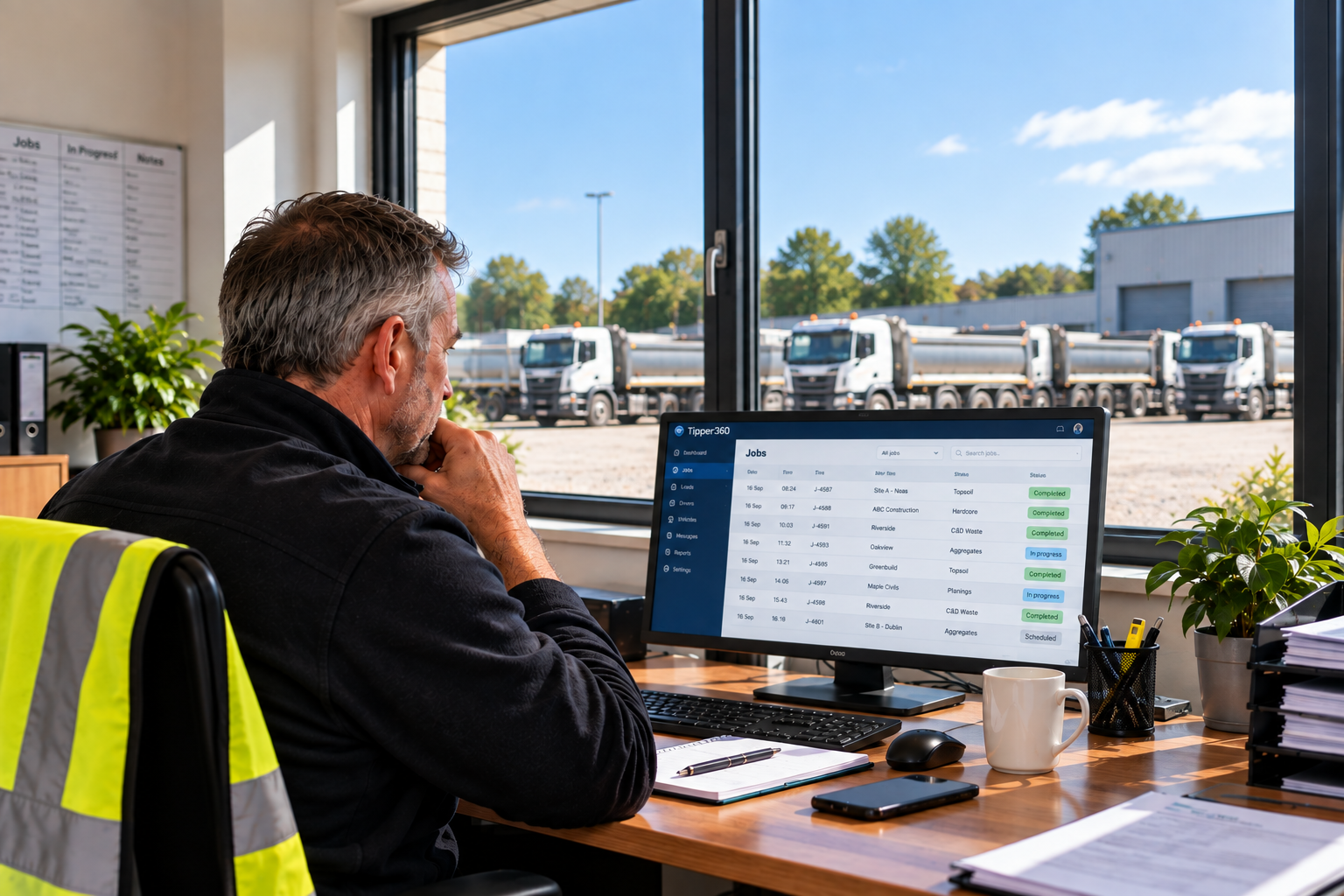
With Tipper360, the office can send a job or an authorised driver can self-start one. The app supports photos and signatures, live chat, subcontractor workflows and offline working. Completed records can then be searched and PODs downloaded when required.
Run a real-world test before changing your process
Choose several normal jobs — not ideal demo jobs. Include a job that changes during the day, a subcontractor movement if you use them, a poor-signal location and a customer POD request. Compare the resulting office work with the way those same situations are handled today.
That will tell you much more than a generic claim about “going paperless”.
Next: Paper vs Digital Delivery Dockets: What Changes for Tipper Operators?