
Could Your Tipper Fleet Do More Work Without Adding Another Truck?
In short: Possibly — but not because software makes a truck drive faster. The opportunity is in the time and capacity lost around the work: getting jobs to drivers, handling changes, finding completed records, answering customer queries and preparing invoices. Recent UK haulage case studies show that better operational systems can help fleets handle more work with the vehicles they already have.
The capacity problem is not always the number of trucks
When a tipper business gets busy, buying another truck can look like the obvious answer. But before adding another vehicle, it is worth asking how much of the existing fleet's day is being lost to avoidable operational friction.
Drivers can lose time waiting for job details or clarification. The office can lose time ringing drivers, matching paperwork to jobs, searching for proof and reconstructing completed work. None of that changes road conditions, loading times or site queues. It does, however, consume capacity around the loads the fleet is already capable of moving.
What UK haulage evidence shows
A useful example comes from Wannop, a Cumbrian quarry and construction group. In a supplier-published HaulierMagic case study, Wannop's 17-vehicle fleet increased from 250 jobs per month to 506, comparing February to June 2025 with the same five months in 2026, while remaining on the same 17 trucks.
That is a striking result, but it should not be treated as a universal benchmark. It is a supplier case study, and Wannop also changed how internal haulage was recorded and priced. The useful point is narrower: the case demonstrates that fleet size alone does not determine how much work an operation can process.
There is supporting evidence from the wider UK bulk-haulage sector. The Society of Motor Manufacturers and Traders reported on A&F Haulage, an aggregates and asphalt specialist operating 230 vehicles from 15 UK depots. A&F said an integrated transport-management system improved productivity and allowed invoices to be processed much faster. The software supplier reported administration reductions of up to 80%.
Again, that 80% figure is a supplier claim rather than an industry benchmark. What matters is the recurring operational pattern: planning, delivery evidence and invoicing work better when the information stays connected.
Where capacity disappears in a tipper operation
The biggest opportunities are often small interruptions repeated across many loads and many drivers:
- Waiting for the office to send or clarify a job
- Calling drivers to find out whether work is complete
- Handling a change of destination or instruction during the day
- Waiting for paper dockets to return before the office can work from them
- Matching photographs, signatures or weighbridge information to the correct load
- Searching for evidence when a customer queries a delivery
- Re-entering information before accounts can prepare an invoice
Removing one of these delays may make little difference to a single load. Across a fleet, every working day, the cumulative effect can become significant.
What Tipper360 changes
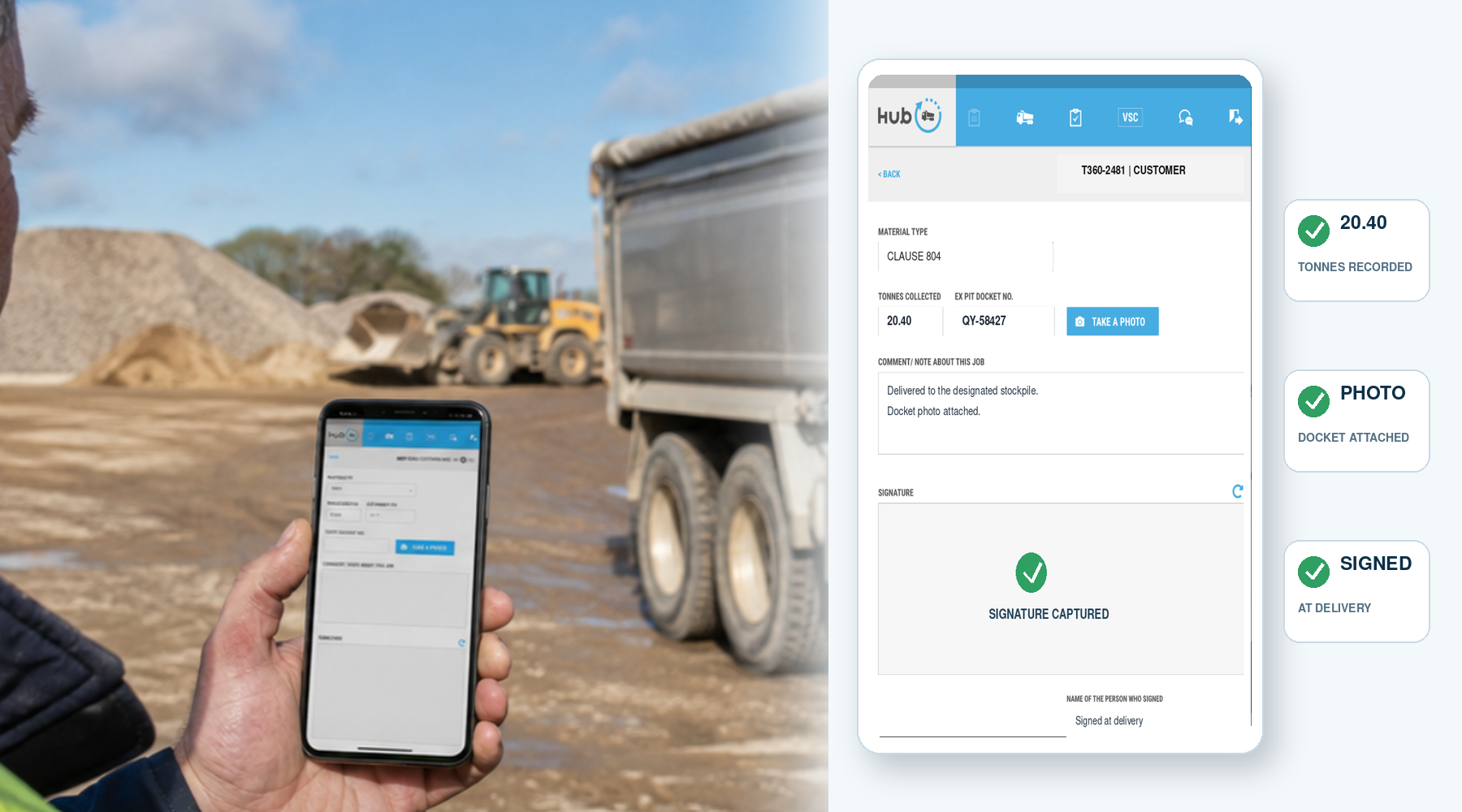
Tipper360 is built around the construction job rather than around generic fleet monitoring. A driver can self-start an authorised job or receive one from the office. The app keeps the relevant job and movement information with the load, supports live chat and job changes, works where mobile coverage is poor and synchronises when connectivity returns.
The office receives the completed digital record without waiting for the paper docket to return. Depending on the job, supporting information such as photographs, signatures and delivery details can stay with that record, making it easier to retrieve later.
That does not guarantee another load per truck, and Tipper360 should not be sold on that promise. Traffic, loading and tipping times, drivers' hours, site queues, vehicle availability and the geography of the work still set hard limits on capacity.
The better question: where is your fleet losing usable time?
Before deciding that you need another truck, look at a normal working week and ask:
- How often are drivers waiting for information from the office?
- How often does the office call drivers for information it could already have?
- Can the office see which jobs are complete without ringing around?
- How long does it take for a completed load record to become usable by accounts?
- How much time is spent finding dockets, photographs or weighbridge information afterwards?
- Can subcontractor work follow the same operational process as your own fleet?
If those questions expose repeated delays, there may be capacity to recover before another vehicle is added.
More work should not mean proportionally more office work
Fleet utilisation is only part of the issue. An operator can move more loads and still create a bottleneck if every additional job produces more manual administration.
This is where digital load records matter commercially. The objective is not simply to replace a paper docket with a screen. It is to make the information created during the job useful to the office afterwards — for customer queries, supporting records and invoice preparation.
The A&F example is relevant here. Its managing director told SMMT that faster invoice processing can have a major effect on cash flow. That is a different benefit from truck utilisation, but the two are connected: growth is much easier to absorb when the office process does not become the limiting factor.
So, can the same fleet do more?
Sometimes. The evidence does not support promising that every operator can double its jobs or produce a fixed percentage improvement. It does support a more practical conclusion: before adding trucks, examine the operational friction surrounding the trucks you already have.
If drivers get clearer job information, changes are communicated quickly, completed load records reach the office without waiting for paper and the evidence is easy to retrieve, the business has a better chance of using its existing fleet and office capacity effectively.
Sources
- HaulierMagic — Wannop case study (supplier-published case study; figures compared February–June 2025 with February–June 2026)
- SMMT — Digital destination: how operators are embracing modern fleet management technology
Evidence and source links reviewed 23 September 2026.
Related guide: See how Tipper360 works from driver to office